Methodology

The IMPACT
System.

One Framework. Seven Steps. Any Industry.

A dual-layer methodology for organizations serious about operational performance. The IMPACT System gives you structure and governance to eliminate inefficiencies, build accountability, and achieve measurable results — without replacing the tools you already have. It is not a product you install. It is a discipline you adopt.

20+
Years in EAM
725
KPI Reference Library
9
Industry Sectors
3
Published Books
7+7
Steps + Disciplines
Dual-Layer Architecture

Two Layers. One System.

The IMPACT System operates on two layers that reinforce each other. The Process tells you what to do. The Method tells you how to govern it. You need both.

The IMPACT Process

Seven steps for turning any maintenance activity from reactive firefighting into a controlled, measurable, repeatable operation. This is the operational layer — the execution engine. Every step has defined inputs, outputs, decision gates, and KPI checkpoints built for Maximo.

The IMPACT Method

Seven disciplines for enterprise operational excellence. This is the strategic layer — the governance framework. It provides the organizational structure, leadership accountability, and continuous improvement patterns that make the Process sustainable at scale.

The IMPACT Process

Seven Steps to Operational Control

01
I — Identify

Identify the Work

Define the scope of work, validate asset criticality, and classify maintenance activities. If you can't describe the work clearly, you can't plan it, schedule it, or measure it.

02
M — Measure

Measure Current State

Establish baseline KPIs before you change anything. PM Compliance, Backlog Health, Schedule Adherence — the metrics that expose where the real problems are hiding.

03
P — Plan

Plan the Approach

Build the execution roadmap. PM programs, job plans, resource leveling, material staging. Planning is where reactive organizations fail — and where controlled operations differentiate.

04
A — Align

Align the Organization

Get operations, maintenance, and leadership on the same page. Governance structures, RACI matrices, communication cadences. Tools don't fix misalignment — structure does.

05
C — Control

Control Execution

Manage work in progress against plan. Scheduling adherence, backlog governance, priority enforcement. This is where the work actually gets done — or doesn't.

06
T — Track

Track Performance

Monitor KPIs against targets. Scorecards, control loops, exception reporting. If your metrics aren't driving action, they're just decoration on a dashboard.

07
• Transform

Transform & Sustain

Close the loop. Root cause analysis on deviations, process refinement, continuous improvement. The goal is not a one-time fix — it is a permanent shift in how the organization operates.

Measurement Architecture

Three Scorecards. Total Visibility.

The IMPACT System organizes maintenance KPIs into three scorecards. Each one answers a different question. Together, they give you complete operational visibility.

OCS

Operational Control Scorecard

Are we executing work as planned? The OCS tracks the mechanics of work execution — scheduling, compliance, backlog health, and resource deployment.

  • PM Compliance
  • Schedule Adherence
  • Backlog Health (Age + Size)
  • Work Order Completion Rate
  • Emergency Work Percentage
CAS

Corrective Action Scorecard

Are we learning from failures? The CAS measures how well the organization identifies, responds to, and eliminates recurring problems. Corrective action, not continuous improvement theater.

  • Repeat Failure Rate
  • Mean Time to Repair (MTTR)
  • Corrective-to-Preventive Ratio
  • Root Cause Closure Rate
  • Failure Mode Recurrence
ROS

Reliability Outcomes Scorecard

Is the asset base getting more reliable? The ROS connects maintenance activities to actual reliability outcomes. This is where the business case lives or dies.

  • Mean Time Between Failures (MTBF)
  • Asset Availability
  • Overall Equipment Effectiveness (OEE)
  • Total Maintenance Cost per Unit
  • Planned vs. Unplanned Ratio
Publications

The Books Behind the System

Each layer of the IMPACT System has its own book. Practitioner-written, Maximo-integrated, field-tested. Not theory dressed up as methodology.
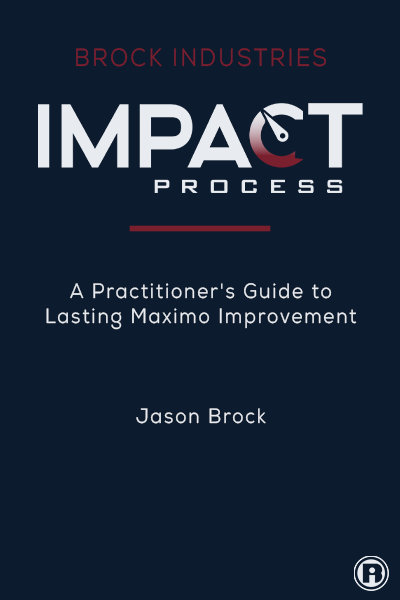
The IMPACT Process book cover
Coming April 2026

The IMPACT Process

The operational layer — seven steps for turning any maintenance activity from reactive firefighting into a controlled, measurable, repeatable process. Maximo field references, KPI checkpoints, decision gates, and the Cool Tools Manufacturing case study throughout.
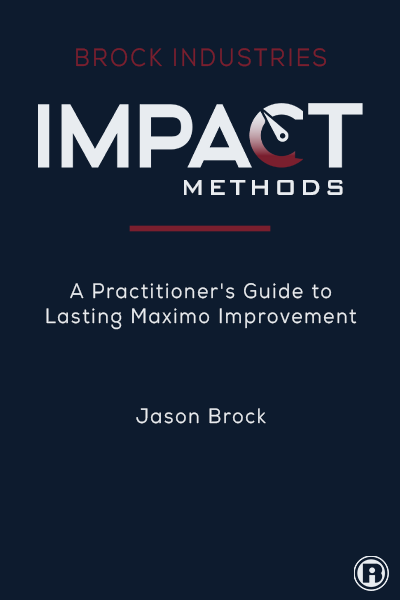
The IMPACT Method book cover
Coming 2026

The IMPACT Method

The strategic layer — seven disciplines for enterprise operational excellence. Leadership accountability, governance architecture, organizational alignment, and the continuous improvement patterns that make the Process sustainable at scale.

The Bookend KPIs

From First Metric to Final Outcome

Every IMPACT engagement starts with PM Compliance and ends with Total Maintenance Cost. These two KPIs are the bookends of the entire system — one measures whether you're doing the work, the other measures whether the work is paying off.

PM Compliance

The starting point. Are the preventive maintenance tasks being completed on time, every time? If this metric is broken, nothing downstream will work. This is where discipline begins.

IMPACT System

Total Maintenance Cost

The finish line. Is all that operational discipline translating into lower cost, higher reliability, and better asset performance? This is where the business case gets proven — or exposed.

Get Started

Ready to Implement
the IMPACT System?

Whether you need an assessment, a structured implementation roadmap, or a second opinion on your maintenance operations — I'm direct about scope, timeline, and what it will actually take.